

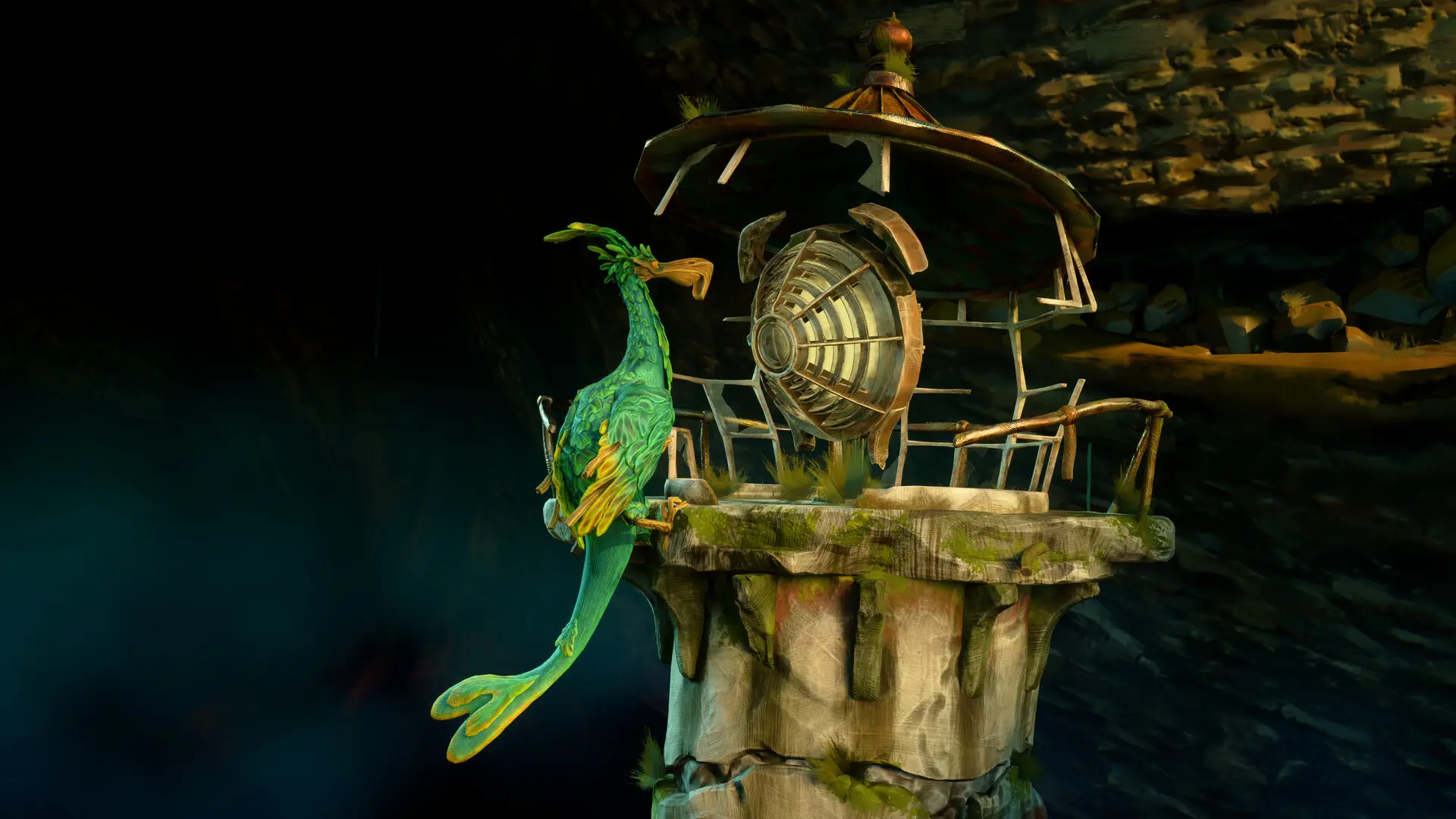
It’s not often we use the word Kaleidoscopic to describe a game for review here at TV Pulse Magazine, but Double Fine’s Keeper is just that — a riotously colorful romp through landscapes so strange and twisted they feel drawn from the palette of a surrealist artist going through a demented polychromatic period.
The game follows the adventures of an anthropomorphic lighthouse who springs to life on two pairs of long crab-like legs at the beginning of the game. In any other setting, those scuttling, disjointed pins would be cause for unease, but Keeper‘s protagonist is far too comical and too delicate to be scary, wobbling around in the early stages of the game like a toddler taking first steps, as it gets used to its new appendages. At any moment the lighthouse looks like it might topple over and crumble to dust, but somehow, miraculously, it manages to remain upright … most of the time.
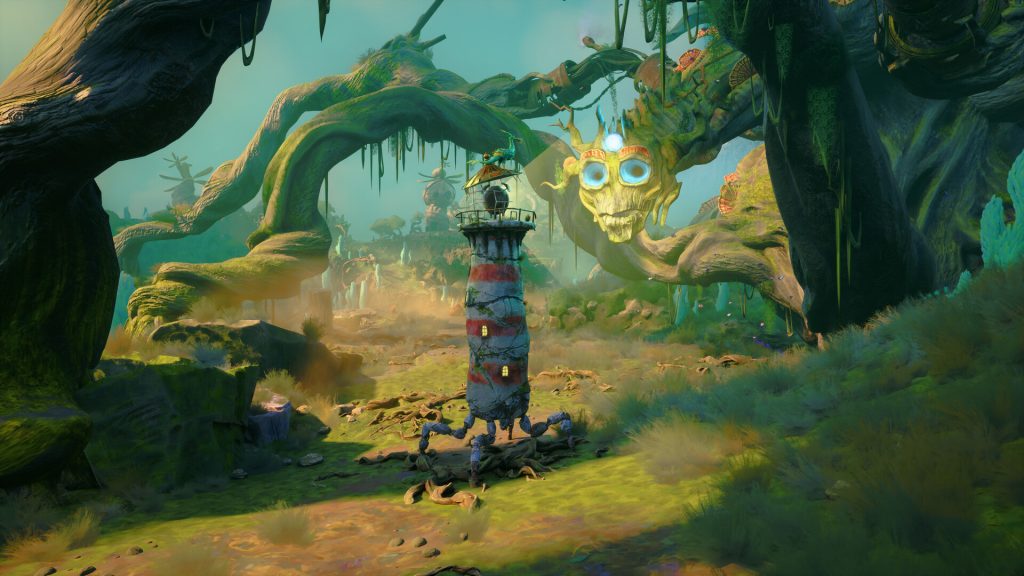
Why did the lighthouse suddenly gain sentience? And why is an exotic bright green gull, Twig, drawn to go adventuring with it? The answers are unclear, with Double Fine preferring players to experience each strange new locale and story beat with the same sense of wonder and surprise as its characters.
Against this backdrop of discovery is the absence of dialogue throughout the game. Nor are there any markers to tell the player where to go next, or how to interact with the environment.
These are quite deliberate choices, the aim of which, no doubt, is to immerse the player in a world where there are no signposts, and no one to tell you what to do next. You really are on your own. In fact the only constant on this journey is a beacon of light shining from a far distant mountain.
Not quite understanding who, what, or where you are, you set out for that distant peak with hope in your mechanical heart and a wobble in your step.
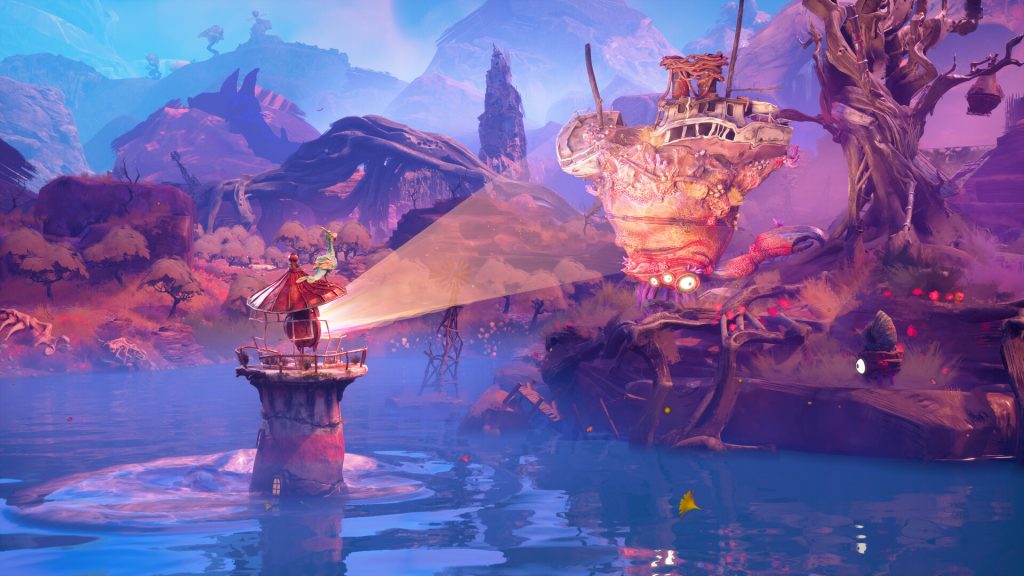
As Twig and the lighthouse progress they uncover a post-apocalyptic word that initially appears to be devoid of life. However, the overgrown meadows, crumbling pathways, and empty villages upon which nature has encroached over time, have also been encroached upon by a much more malevolent force known as The Wither.
Spiked purple vines block paths. Scuttling purple beetles attempt to swarm both the lighthouse and its companion, and would succeed if not for the lighthouse’s bright light, a beam that can be rotated and directed at foes, obstacles, and doors, to clear a passage for our unlikely explorers.
Along the way our duo will encounter environmental puzzles that require them to team up. Players can instruct Twig to fetch a newly discovered object (lighthouses don’t have hands!), or to pull a lever, or rotate a crank. Twig can also tear down vines, shake fruits from trees to share with cute critters or to encourage larger critters to budge.
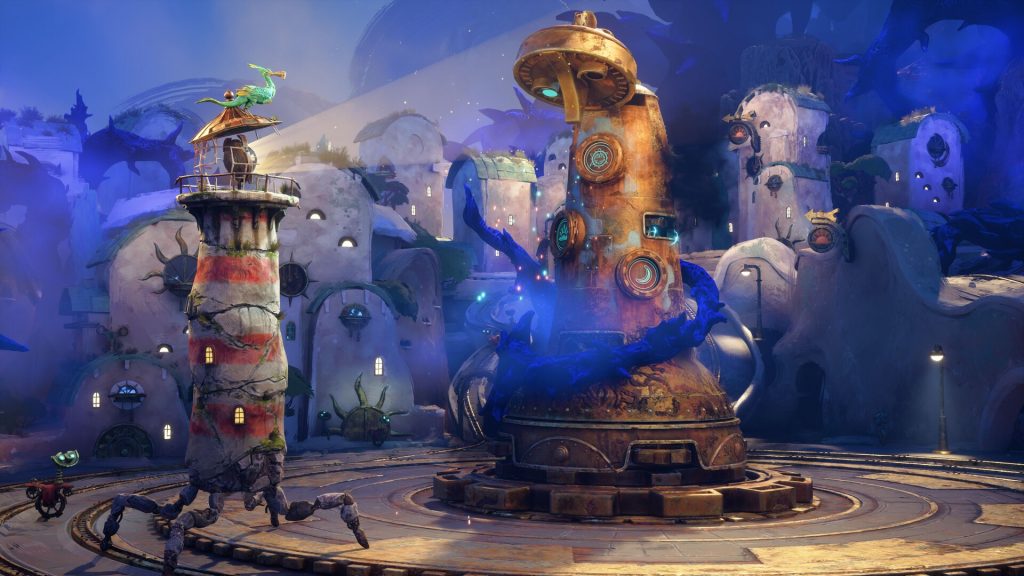
Initially the puzzle-solving is quite simple, but becomes delightful a little later when the pair discover a robot village in which time can be forwarded and rewound at will.
Rewind time and Twig is instantaneously transformed into an egg — a handy way to weigh down a heavy plate perhaps? Fast forward however, and Twig disintegrates to bones and dust before your very eyes (Wait. Do you have actual eyes?), transforming into a ghost who can now fly through locked doors and other areas inaccessible to the corporeal.
The mechanic is as delightful as the village and its tiny inhabitants going about their day beneath your giant lighthouse legs.
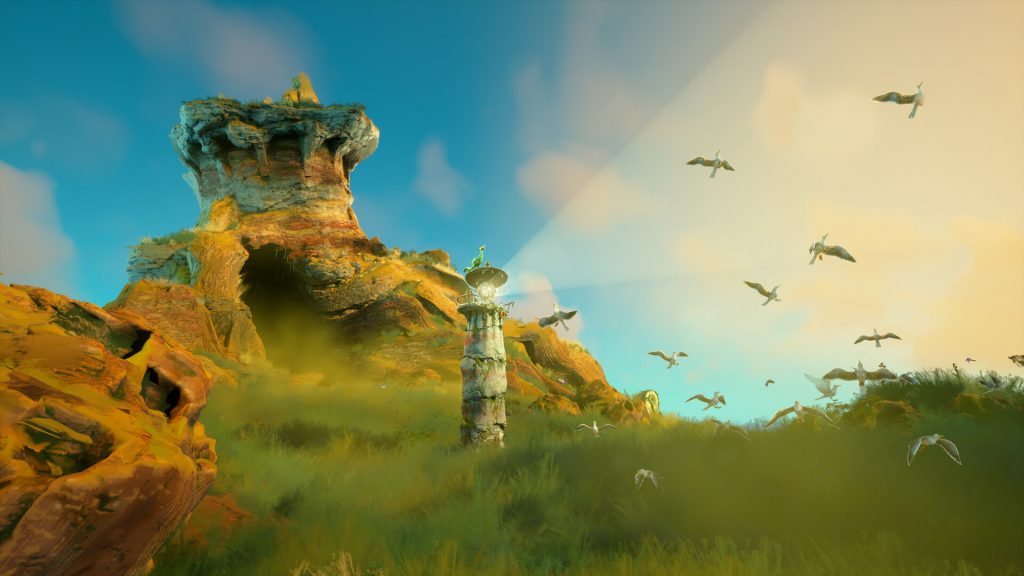
Despite its many quirky and colorful delights, there are some things that frustrate in Keeper. When entering a new area, the game’s locked camera angle has a tendency to shift perspective to point towards whatever object or pathway looks the most interesting. The switch up means you’ll occasionally find your forwards/backwards and right/left controls reversed as the game resets your position.
Additionally, tightly fixed camera controls (reminiscent of ancient titles like Alone in the Dark, and early Resident Evil entries) often make exploring an unintuitive and clumsy affair.
Doubled with the game’s bright, psychedelic environments, twisted passages, and spiralling staircases, getting about in Keeper can be a tricky affair — even more so when you’re an ancient crumbling building drunkenly listing about on top of four crab legs.
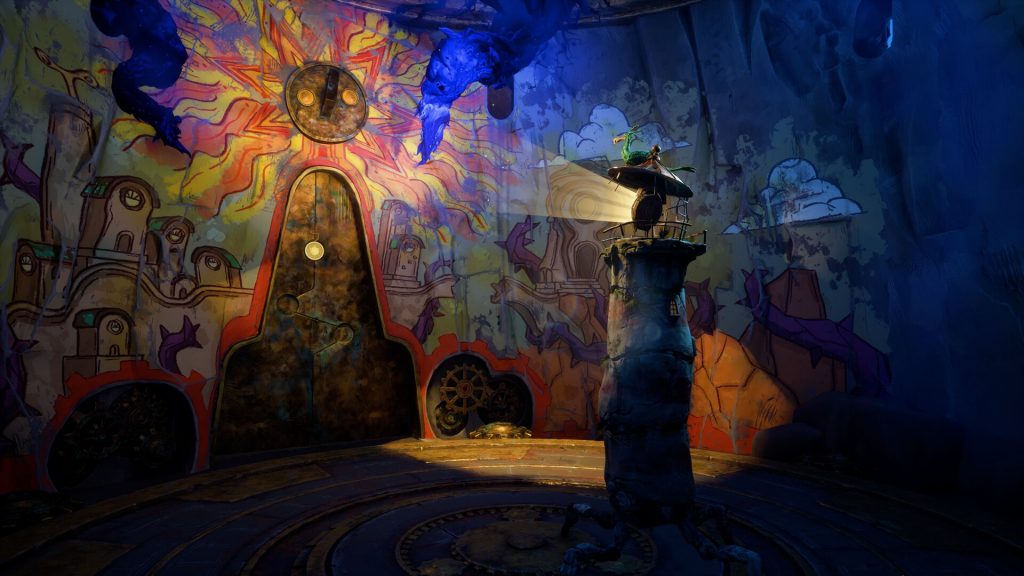
Keeper’s narrative too is a tricky one, and reminiscent of recent titles like this year’s Herdling, last year’s Harold Halibut, and the 2024 animated movie Flow. Like Keeper, these gentle character-focused titles hinted at a larger story and setting, but let players and viewers largely decide for themselves what that story was, favoring the journey over the final destination.
If you don’t particularly mind the hows and the whys, Keeper‘s simple and somewhat nebulous story will sustain you until the closing credits. And maybe after.
It’s hard to stay mad at Keeper‘s minor frustrations for long though. The game is simply too charming and otherworldly, and its final hour too joyful. Each new location buzzes with curious, ridiculous life, from the tiny creatures running around underneath your feet, to hulking oblivious leviathans who amble past you in the distance, to the dazzling flora that makes every frame look like a work of art.
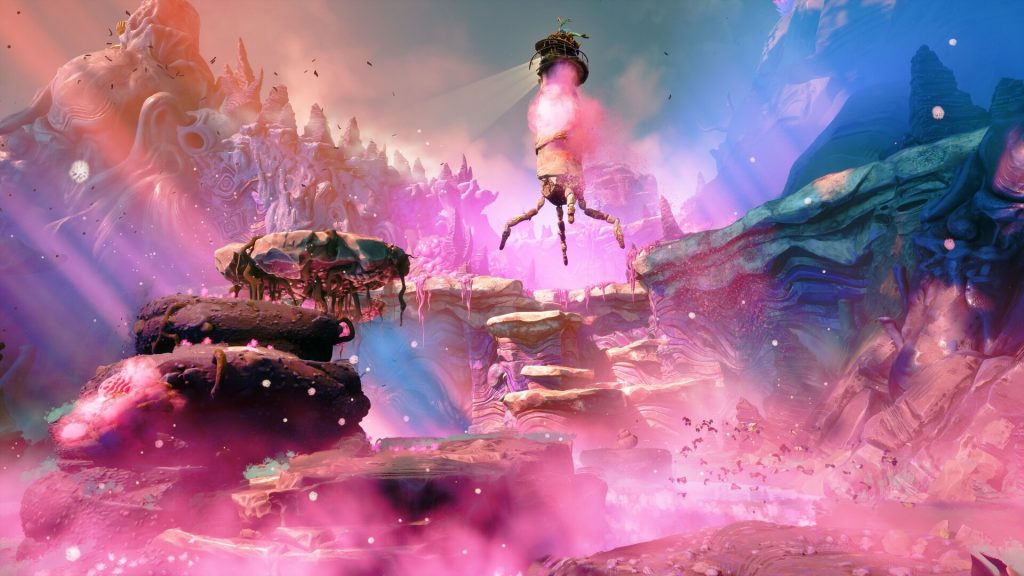
But Keeper is not just a feast for the eyes. Your heart will likely grow a couple of times in size as you steward the awkward lighthouse and its scrappy bird companion to new heights, watching as their bond grows with every clumsy step taken together.
In the end, this particular lighthouse shines brightest not as a puzzle masterpiece or a narrative tour de force, but as a tender reminder that the most profound adventures often begin with a single, unsteady step.
Our Score: 8/10 Double Fine has crafted a world that’s equal parts whimsy and wistfulness, where exploration feels like a gift rather than a grind. If you’re weary of open-world checklists and dialogue trees that branch into oblivion, Keeper offers a refreshing detour into pure, unguided, and at times unhinged, imagination.
Platforms: PC, PlayStation 5, Xbox Series X/S, Nintendo Switch. Developer: Double Fine Productions. Publisher: Xbox Game Studios. Release Date: October 17, 2025.
Keeper: This particular lighthouse shines brightest not as a puzzle masterpiece or a narrative tour de force, but as a tender reminder that the most profound adventures often begin with a single, unsteady step. Double Fine has crafted a world that's equal parts whimsy and wistfulness, where exploration feels like a gift rather than a grind. If you're weary of open-world checklists and dialogue trees that branch into oblivion, Keeper offers a refreshing detour into pure, unguided, and at times unhinged, imagination. – jgriffin
