

Before Ocean Software became famous for movie tie-ins and arcade ports, it made something stranger and more original. That something was a top-down sci-fi shooter that demanded infinite wells of your patience, punished your every reckless move, and even hid some grafitti in its walls in a relatively new technique called environmental storytelling.
We’re going to need to go waaay back in time for this one. To 1986 to be specific, and a particular kind of memory that belongs exclusively to the ZX Spectrum. Think of the smell of warm plastic (but at the same time try to forget, if you can, that one time your little brother threw up on the keyboard), the screech of a cassette tape loading, and the aggressively vivid bands of color assaulting your TV screen and your eyeballs Don’t worry. It’s all there to reassure you, that yes, your game is still loading correctly! For those of us who grew up in Europe, and particularly in Ireland and in the UK in the early to mid-1980s, these nostalgic footnotes represent the entire texture of how we first encountered interactive worlds. N.O.M.A.D. is one of those worlds. And it deserves to be remembered with a bit more clarity, and a lot more love, than it is.
Released late in 1985 by Ocean Software and landing on the ZX Spectrum and Amstrad CPC in 1986, N.O.M.A.D. — Nemesis Organisation Mobile Attack Droid (yes, someone really wanted it to spell out that word) — was, on paper, a straightforward top-down arcade shooter. In practice, it was considerably more interesting than that. It was also something of an anomaly in Ocean’s catalogue at the time: an entirely original game, conceived and crafted by a small team with no franchise safety net, in the middle of one of the most commercially frantic periods in British gaming history.
To understand what N.O.M.A.D. represented, you first need to understand the peculiar industry that produced it. Ocean Software was founded in Manchester by David Ward and Jon Woods, two businessmen who had previously run a youth clothing operation and who spotted an opportunity in the rapidly expanding home computer market. By the mid-1980s, they had built one of the most powerful software houses in Europe, operating out of offices that, by all accounts, were a magnificent, chaotic mixture of serious commercial ambition and barely-suppressed adolescent mayhem.
The British games industry of this short-lived but explosive era was unlike anything that existed before or since. The 1983 video game crash that devastated the American market barely grazed these shores, largely because home computers, not consoles, were the platform of choice for British families.
The ZX Spectrum alone would go on to sell over five million units. By the end of 1983, there were more than 450 companies in Britain selling games on cassette. Bedroom coders were earning serious money. The whole scene had the chaotic energy of a gold rush, staffed by people who had wandered in almost by accident and stayed because the work was extraordinary.
Ocean thrived in this environment, but by 1985 the company was beginning its pivot toward licensed properties, with The Never Ending Story becoming its first movie tie-in that year, and Rambo, Short Circuit, and Miami Vice following in 1986.
These were the titles that grabbed headlines, drove volume, and graced magazine covers. Against this backdrop, N.O.M.A.D. was something of a quiet outlier. Nobody had paid for the rights to the Nemesis Organisation Mobile Attack Droid. There was no movie poster to copy. It was just a game born out of an idea for a robot shooter.
The team responsible for N.O.M.A.D. was small even by the standards of the day. Game design and in-game graphics fell to Simon Butler and Ian Weatherburn, with Roy Gibson handling the code. The cover art, that critical first impression on the shelf, was the work of Bob Wakelin.
Simon Butler was, in retrospect, one of the more remarkable figures of the era. Credited with over 260 individual titles across a career spanning Ocean, Team 17, Atari and beyond, he came into the industry entirely by accident, originally planning a career in advertising before a friend named Steve Cain offered him three days of conversion work at Imagine Software in Liverpool. He knew nothing about home computers. He turned up, did as he was told, and was paid what he describes as “an obscene amount of money for very little work.”
Butler never looked back.
“Ocean was like working in a madhouse at times… it was a hive of industry that really did buzz with excitement on a daily basis, sporadically interrupted by hi-jinks.” — Simon Butler
Butler’s recollections of Ocean are characteristically vivid. He described it as a serious business run by people who had learned from past mistakes, but also a place where a junior team member might spray the ceiling of development manager Gary Bracey’s office with beer during an impromptu party (an incident that left permanent stains, both physical and reputational.) There was, he recalls, a staff member who took great delight in dropping a glass eye into colleagues’ drinks. The tales, he has said, would fill a book.
This was the creative environment in which N.O.M.A.D. was conceived and built.
The premise of N.O.M.A.D. was delightfully pulpy. Galactic supervillain Cyrus T. Gross has constructed TALOS, a man-made asteroid, and is directing it toward Earth. You are Droid 471, the Nemesis Organisation’s Mobile Attack Droid, and your job is to navigate through the armoured corridors of TALOS, solve some basic maze and lever puzzles, destroy enemies, and eliminate Gross himself.
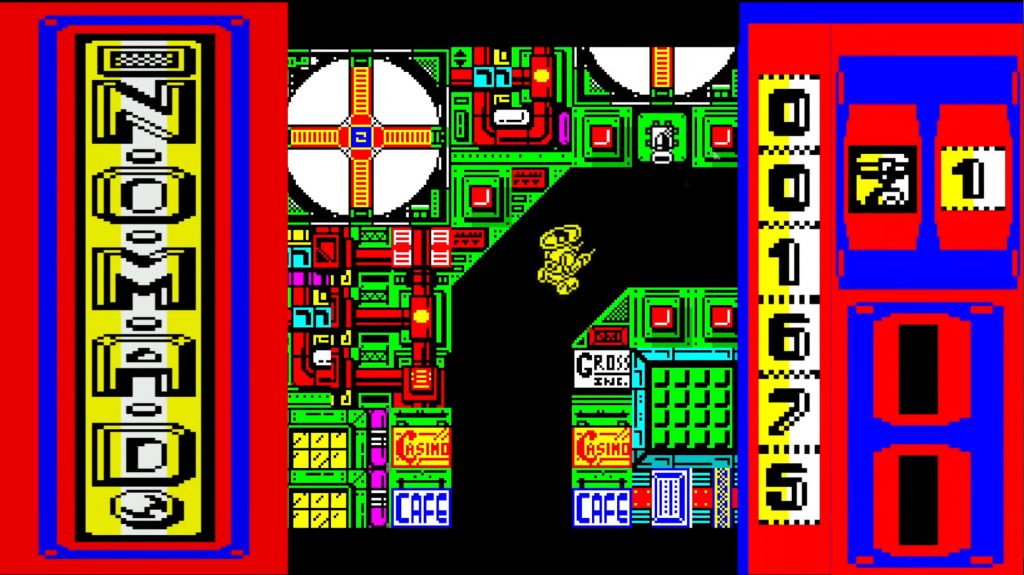
Out in the vastness of space lies the heart of an Intergalactic Criminal Network, TALOS, a man-made asteroid slowly spinning through the void, spreading its evil through the Universe. At the head of this seemingly unstoppable force sits one man, the unspeakably vile Cyrus T. Gross.
A name spoken only in whispered voices, Gross is the embodiment of all that is criminal. Avoiding any attempt to curtail his ever-spreading empire, he has crushed all opposition and seems invincible, ruling his depraved Zealots with a fist of iron and a heart of ice.
In a last-ditch attempt, the rulers of the Free Worlds have called in the Nemesis organisation, a hardened cadre of humanoid and robotic freebooters who have assigned N.O.M.A.D. 471 (Nemesis Organisation Mobile Attack Droid) to penetrate Gross’s heavily armed home-world and destroy this vile despot once and for all.
Your mission is to guide N.O.M.A.D. through the four sections of Capital City towards Gross’s inner sanctum. You arrive at the spaceport and must then progress through the slums, into the city centre and penetrate the HQ; “Dun Dentin’, before you reach his personal quarters for the final deadly confrontation. Many dangers await you in all sections of Capital City. In true cowardly style, Gross has installed magnotrons, heat-seeking missiles, and an infinity of equally deadly obstacles, all of which must be confronted and conquered.
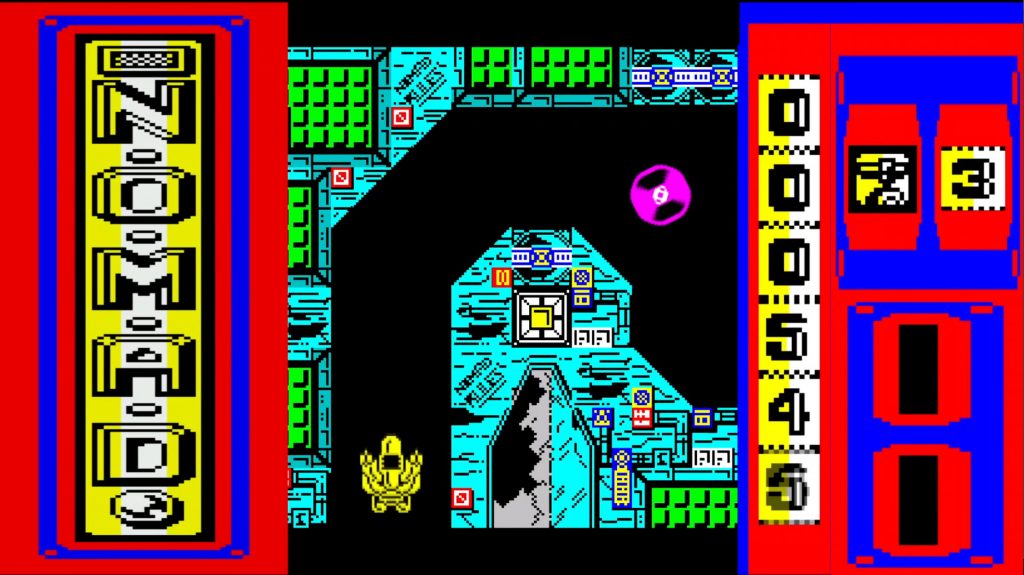
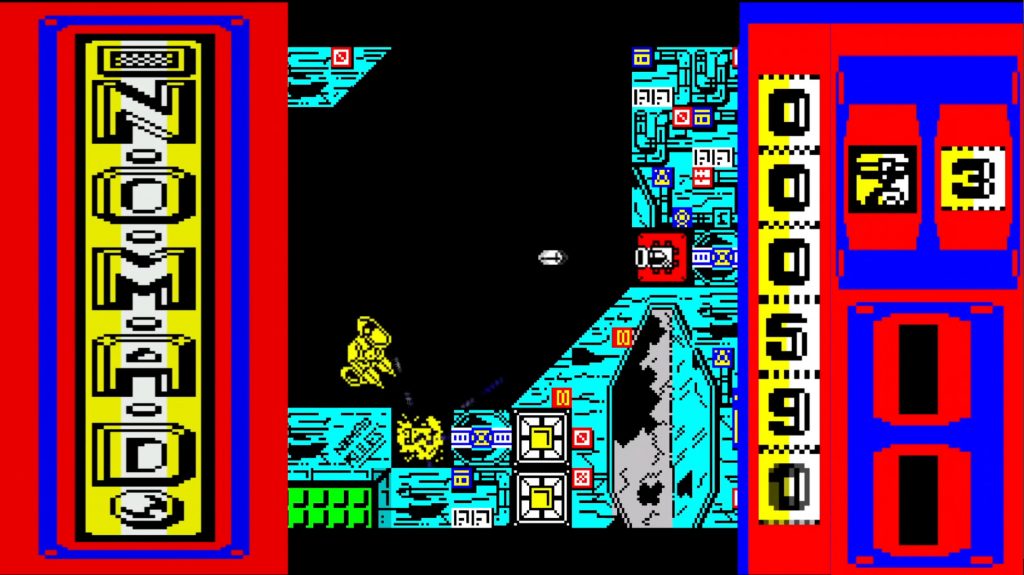
What distinguished the game mechanically was its movement system. Rather than the simple eight-directional controls that most contemporary shooters offered, N.O.M.A.D. gave you a robot with genuine inertia and momentum. You rotated left and right, applied thrust to move forward, and had to think carefully about deceleration. The droid did not stop when you stopped pushing. It kept going, gradually slowing, occasionally bouncing off walls with consequences you hadn’t planned for. Some rooms disabled this inertia entirely, which added another layer of tactical adjustment. In other rooms, gravity would stick your droid to a wall or floor, and most often into the line of a fire of a turret spitting bullets in your direction.
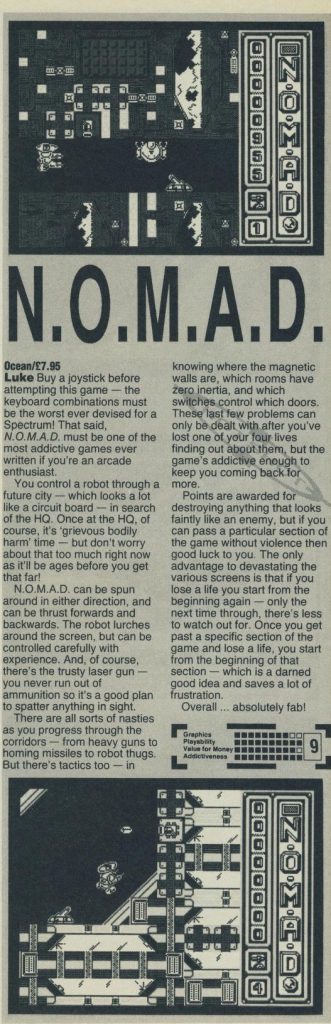
Contemporary reviews recognised this immediately as both the game’s greatest challenge and its most compelling feature. One critic, writing at the time, noted that manoeuvring Droid 471 accurately was ‘a difficult task at first’ but that ‘it is a measure of how playable the game is that you carry on despite the frustration.’ That tension between difficulty and compulsion is a fine line to walk, and N.O.M.A.D. walked it well.
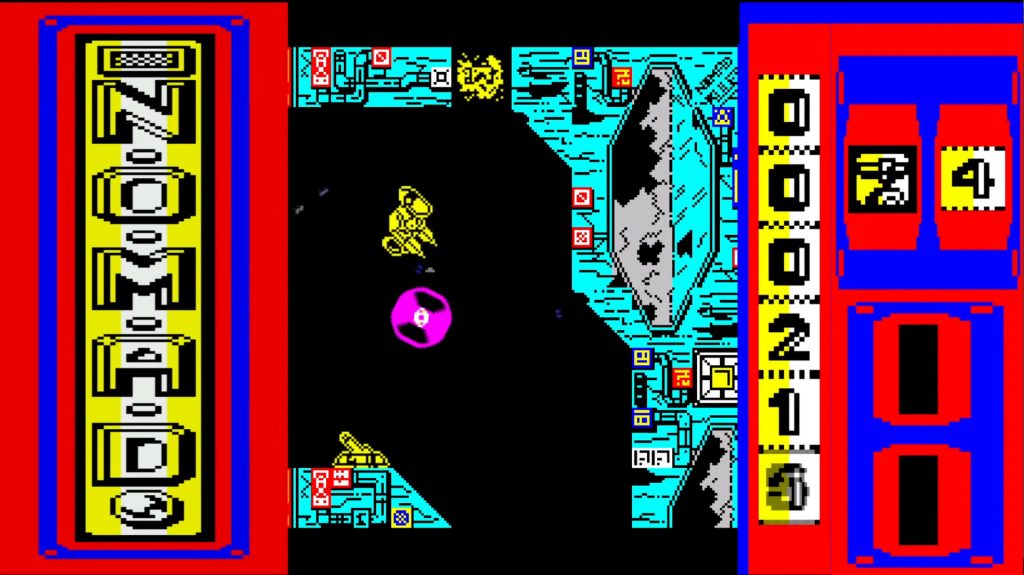
The droid itself was beautifully designed. Larger than most sprites-navigating-a-maze-style games at the time, Droid 471 had fluid forward and backward movements that altered its appearance as it moved, gave an impression of forging bravely ahead with its little head jutting optimistically towards the next screen, or pulling back hastily under a hail of fire, by turns. For those playing with a joystick, the auto-fire option provided a steady ‘bock-bock-bock’ stream of bullets from the droid’s twin arm guns, granting an extra layer of comfort in areas where invisible enemies could materialize literally right in front of you.
The level design was colorful and clear, and made the best use of the Spectrum’s limited colour palette by refusing to overcrowd the screen with details. It also rewarded exploration and punished impatience. Remember, these were the days when a single shot from an enemy wall turret, or being bushed up against by a roving enemy meant instant death. Switches operated doors, but not necessarily the nearest ones. Working out the connections was part of the game. Enemies could be avoided as well as destroyed, and there was a strategic logic to prioritising certain targets. Most impressively for 1985, the game featured checkpoint-style progression. Lose a life partway through a section, and you restarted that section rather than the entire game. This sounds unremarkable now, but at the time it was a genuinely player-friendly design choice that many contemporaries had not yet adopted.
The graphics matched the ambition of the design. One level in particular was noted for its visual storytelling: a section that bore all the marks of inner-city deprivation including torn metallic panels, blast-damaged equipment, graffiti covering the walls. If you looked closely enough at that graffiti, you could make out the words: ‘Nomad rules.’ It is a small detail, but it is exactly the kind of detail that separates a game made with enthusiasm from one made to a deadline.
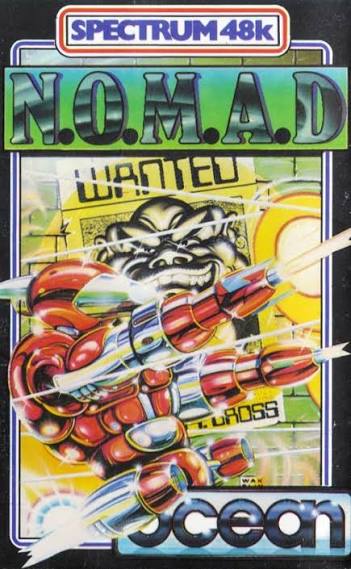
In the era of cassette-based gaming, the cover art was often the first and only marketing a game received. You saw it on the shelf, or in a magazine advertisement, and you made a decision. Ocean understood this better than almost anyone, and for over a decade the job of translating their games into irresistible visual promises fell to one man: Bob Wakelin.
Wakelin was an illustrator based in Liverpool who had done comic work for Marvel and spent a short, improbable interlude as a member of a post-punk new wave band called Modern Eon before finding his way into the games industry. He refined Ocean’s logo, originally created by a local printer, into the iconic, more illustrative version that would define the label, and went on to create the cover artwork for a remarkable proportion of their catalogue: by his own estimation, close to a hundred pieces over more than a decade. He also, by his own admission, had very little interest in actually playing the games he was illustrating.
This professional detachment arguably made him better at the job. Working often from nothing more than a title, a brief description, and an early demo, Wakelin produced covers that were cinematic, bold and frequently more exciting than the products they contained. Ocean knew this. When a game was a known disappointment, Wakelin’s brief would sometimes be extended. Get the box looking extraordinary, and the game will shift regardless. He was, in a very literal sense, the most important salesman in the building.
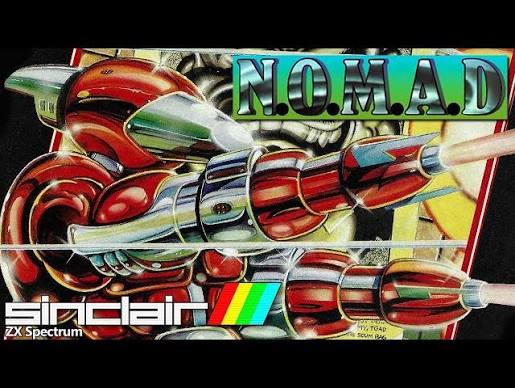
The N.O.M.A.D. cover was a fine example of his work: a chrome-edged robot full of implied momentum against a backdrop of hostile sci-fi corridors, the whole thing rendered with the kind of airbrush confidence that made 1980s box art its own aesthetic genre. Wakelin passed away in January 2018 after a long illness. He was a regular presence at retro gaming conventions in his later years, always willing to sign prints, always happy to talk. His work remains one of the defining visual languages of British gaming’s golden era.
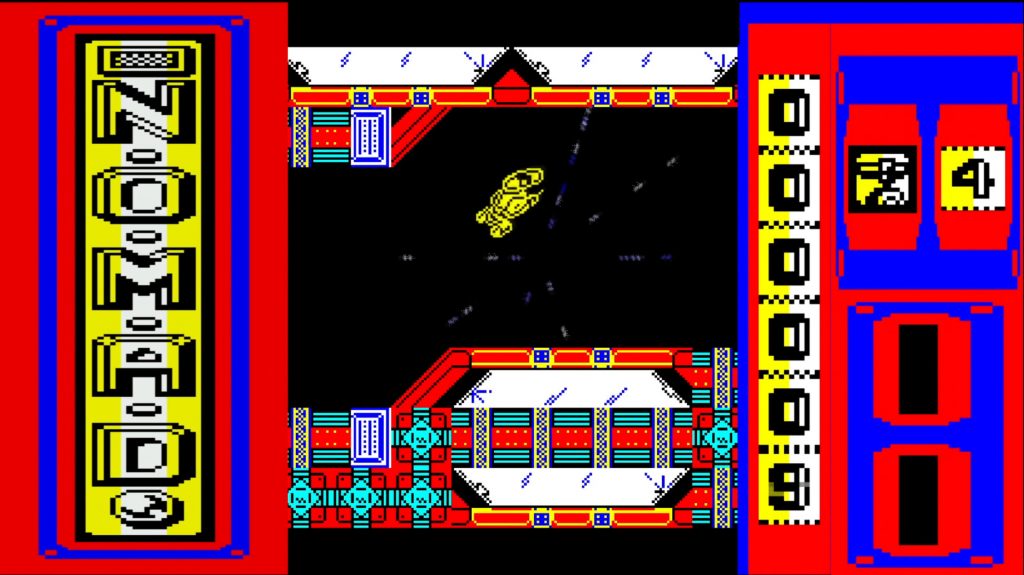
N.O.M.A.D. was not a runaway commercial success. If it was, I may not be writing about it today. It was, at the time, a well-reviewed, fondly regarded game that earned its place in Ocean’s catalogue without ever quite achieving the profile of the company’s bigger licensed titles. Your Sinclair gave it a Hot Shot award. Computer and Video Games declared it a C+VG Hit. It was included in compilation discs and remembered warmly by the people who played it. Then, as happened to so many games of its generation, it quietly receded from view.
Except that it didn’t, quite. In December 2020, Pixel Games UK released NOMAD Revisited on Steam. The game is a faithful remaster of the original, rebuilt in Unity, with an optional new inertia control system that modernises the movement without abandoning what made the original distinctive. It costs under two pounds. The fact that someone thought it was worth remastering at all says something meaningful about the game’s grip on a certain generation of players.
And in 2022, the original game was re-released on Steam as part of a bundle of classic Ocean and Spectrum titles, making it accessible to players who weren’t alive when it was first released.
N.O.M.A.D. has now survived four decades, two remasters, and the complete collapse and rebirth of the industry that made it.
That’s more than most games from 1985 can claim, and probably more than anyone at Ocean expected when they shipped it. What that survival actually means is harder to pin down than nostalgia usually admits. The game wasn’t a landmark at the time. It didn’t define a genre or launch a franchise. What it did was get the balance right between mechanical difficulty and genuine playability, anticipate design ideas that would take years to become standard, and hide a little joke in the graffiti on a virtual wall because the people making it were paying attention. In a moment when speed was the only currency that mattered, that’s a rarer achievement than it looks.
Simon Butler went on to clock up 260-odd credits across three decades. Bob Wakelin spent his later years at retro conventions, signing prints of cover art for games he’d never played, for people who remembered them better than he did. Roy Gibson’s code is still running, after a fashion, in a Unity wrapper on Steam. None of this adds up to a tidy story about genius or vision. It adds up to a small team who made something very cool, and very carefully, in a chaotic industry that rewarded speed over craft. A game good enough that strangers are still finding it forty years later.
It was, by every measure that matters, a very good game.
N.O.M.A.D. (1985) is available on Steam via the N.O.M.A.D. (CPC/Spectrum) bundle. NOMAD Revisited (2020), the faithful remaster by Pixel Games UK, is also available on Steam.
