


We’re stepping back in time in this latest Revisited column… to 1986 to be precise, and a tense situation on the Northern Ireland border, just a couple of days before Christmas.
Picture the scene: It’s late at night. My father, and his eldest son are both sitting on a Dublin-bound coach from Belfast about to cross the Northern Irish border back into the Republic. In the storage compartment above my Dad’s head is a modestly sized shopping caddy — or Granny Cart — filled with duty-free Christmas foodstuffs he’s deliberately crossed the border to the North to buy more cheaply, a common holiday custom in 1980’s recession-strapped Ireland.
Hidden at the bottom of the cart is a gaming console — the ZX Spectrum 128k+2 — the most expensive and exciting Christmas gift Santa will ever leave the 5 Griffin siblings, and one that will continue to resonate, in big ways and small, to this very day. But there’s a snag. British soldiers have boarded the bus. They have guns, and they look cranky. They’re here to complete a last minute border check for goods incurring duty charges. They’re willing to overlook boxes of cookies, and the odd Christmas cake, but smuggled electronics will definitely be confiscated.
There’s a tense stillness on the bus as its passengers silently consider their own booty, each wondering if they’ll be singled out for inspection. My autistic older brother is barely able to keep himself in check and has begun talking loudly the “Spectrum” and my beleaguered Dad is forced to step outside with his purchases to explain what his son is talking about. He is told to open the shopping caddy, and the soldiers cast a wary eye at its contents. It’s packed tightly to the brim with USA, Afternoon Tea, and Quality Street. It’s almost Christmas. Everyone is tired. Who knows what the kid with the Autism is actually saying? No one has the will to dig deeper into the cart. The passengers on the bus are growing restless and resentful and the soldiers more wary. No one wants a holiday incident. My Dad is allowed back on the bus with his hidden contraband, and we wake on Christmas morning to the sight of our very first computer console, unaware of the circuitous route Santa took it get it to us.
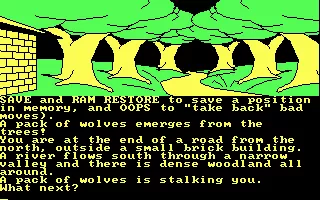
Along with the classics — Elite, Mikey, Chucky Egg, Panama Joe (known as Montezuma’s Revenge in the US), Paperboy, and others — is Jewels of Darkness, a trilogy of text adventure games developed by Level 9 Computing and published by Rainbird Software. (Rainbird coincidentally went on to publish Starglider, a space combat sim, and another of my favorite games from the 80’s.)
Jewels of Darkness was a landmark 1986 release for both the ZX Spectrum and Commodore 64. It was actually a compilation of previously individually released titles that contained a series of “heavily-inspired” Tolkien elements and references that had to be stripped out for legal reasons to do the with Tolkien estate before being re-released. Comprising Colossal Adventure, Adventure Quest, and Dungeon Adventure, this trio of games, now reworked, retooled, and bundled together as a trilogy for the first time, offered a cohesive fantasy narrative across three distinct but interconnected adventures, each taking place at a different time in the fantasy land’s history.
The middle of 3 sisters, I was awed and inspired to discover the gushing river in my older sister’s game was a thin trickle running through a gully in mine, and a dry dust bed in my little sister’s. This attempt at a unified vision across all three games, geographically at least, was simply unparalleled at the time.
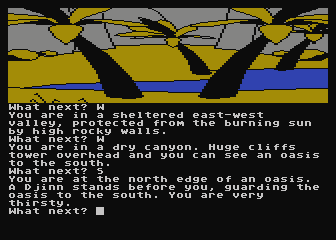
Jewels of Darkness wasn’t the first text adventure game of its kind. In fact, the series’ debut title, Colossal Adventure, was a direct reimagining of the 1970s classic Colossal Cave Adventure. Originally developed in 1975 for mainframe computers by Will Crowther and Don Woods, that foundational game is widely recognized as the birth of text-based gaming. It drafted the blueprint for interactive fiction: players explored a virtual world (a cavern system inspired by Kentucky’s Mammoth Cave) by typing text commands to navigate, collect treasures, and solve puzzles. These structural foundations helped shape the entire adventure genre for decades to come. Today, there isn’t a modern action-adventure or RPG that doesn’t have a piece of Colossal Cave Adventure in its DNA.
Jewels of Darkness’ version — Colossal Adventure — was both an homage and an update to Crowther and Woods’ vision, faithfully recreating the original’s core structure, while expanding it with additional puzzles, an endgame sequence, and, in the 1986 Jewels of Darkness release for Spectrum and Commodore, static graphics and enhanced text descriptions. In one of many nods to the grandfather of all games, Colossal Adventure even included the “You are in a maze of twisty little passages, all alike” line from the original game.
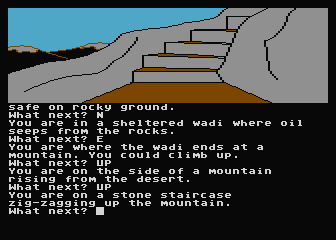
Advenuture Quest, set in the same world, shifted focus to defeating the Dark Lord Agaliarept. It was both a more linear and puzzle-heavy game, demanding careful exploration and creative problem-solving. I had to write to Level 9 to request a solution in order to cross the vast desert (avoiding the giant sandworm) and gain access to the Black Tower on the other side. The code N, N, N, W, N, WAIT, E, E, E will forever be ingrained in my memory. Ok, that sequence may look fairly straightforward to modern players, but at the time it felt fiendishly difficult, as venturing off in the wrong direction meant death by sand worm or dying of thirst in the endless desert.
Finally, in Dungeon Adventure, the trilogy’s finale, players scoured the Demon Lord’s cave network for treasures post-victory. In many ways this third entry felt like the most original of the three games, with a darker tone and a more complex map that built on the previous games’ mechanics. Puzzles were more fun too. A statuette of a many-armed Goddess could be held aloft to brighten a dark and treacherous cavern, based on the logic many hands make light work.
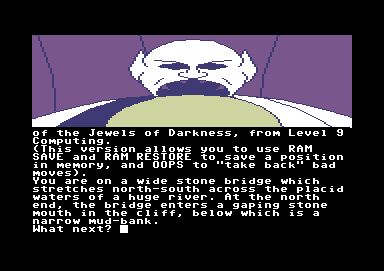
In all three entries gameplay was consistent and revolved around text-based input, where players typed commands in response to the question WHAT NEXT? Specific commands could be typed to navigate, interact with objects, and solve puzzles. The parser, improved from earlier releases, allowed the player to type basic phrases such as GET LAMP. LIGHT LAMP. EXTINGUISH LAMP. CLIMB LADDER. EAT SANDWICHES. DROP GOLD and so on, but also to issue longer and more complex phrases like EXAMINE WATER BOTTLE THEN DROP ALL BUT RUSTY KEY. At the time, this run on series of commands was quite the flex! Players could also access their inventory using INV, reacquaint themselves with their environment with LOOK, save their game in progress and load it later with RAM RESTORE, take back a bad move with an OOPS command, and even choose to be resurrected in the event of death by misadventure.
The OOPS bad move/character resurrection commands were a novel addition for 1986 when games were often a merciless grind and a test of stamina and willpower that could break your heart. As a side note, Hideo Kojima’s 2025 Death Stranding 2: On the Beach garnered criticism recently for a similar inclusion in the form of a “Pretend you Won” option for tough boss battles. While some gamers feel modern titles are trending downwards with respect to skill in an effort to pander to the unskilled and unserious gamer, it’s worth noting the ability to pretend you didn’t die has been around for decades.
Such an interface may seem clunky in the extreme by modern standards, and there certainly was room for the occasional misinterpreting of commands. (GET RED ROBE might return I DO NOT KNOW WHAT YOU MEAN BY THE RED ROBED FIGURE FLEES UP THE CORRIDOR — a hint we’re about to meet a red robed figure fleeing up the corridor in the near future. At the time I found this parsing error hilarious and would spend a lot of time trying to get the game to accidentally spit out more spoilers with similar command structures). Likewise, some of the puzzles were illogical or overly obscure, while others were tediously basic. It was a mixed bag.
However, the trilogy’s scope, with hundreds of locations and intricate puzzles, truly was a deeply ambitious affair. Detailed prose and atmospheric settings immersed players in a rich fantasy world, despite the technical limitations of the time, and the games sought always to reward patience and creative thinking — the hallmarks not just of classic text adventures but modern puzzle-solving games too.
I feel a little embarrassed to be moving on to talk about graphics, because there were none. Or very little, at least. The ZX Spectrum version of Jewels of Darkness contained only occasional random static graphics — a stand of trees, a tall tower, a room displaying a series of doors — which added some spice to lengthy text descriptions. I believe the Commodore 64 version suffered from even less vibrant and even more more blocky visuals, if you can imagine such a thing. Looking back in 2025 at images for use in this article I can’t tell which looks worse, but I can tell you I don’t remember them looking bad at the time. Jewels of Darkness was a game series for players with vivid imaginations. For a 14 year old girl who had never seen a computer before, the rain-softened forests, imposing stone towers, vast sun-scorched deserts, and chilly damp caverns echoing with each footstep taken were as real as I wanted them to be.
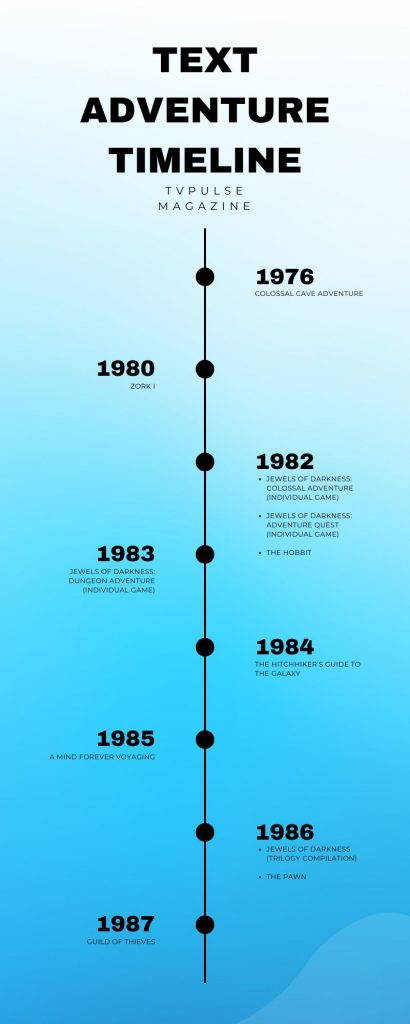
Jewels of Darkness didn’t stand alone as the only text based entry of the 80’s. Other games such as The Hobbit, A Mind Forever Voyaging, The Pawn, and others were also capturing imaginations at the time. However, JOD distinguished itself by offering what other titles did not: that powerful novel parser, capable of handling more complex commands, an expansive trilogy structure integrating hundreds of locations across three individual games, and the aforementioned addition of (albeit static) graphics. The overall effect was a mesmerizing sense of immersion beyond the text-only formats of its contemporaries — and all from an 8-bit system with just 128 kilobytes of memory. I was utterly enchanted.
It’s not only now that we can look back and recognize Level 9’s contribution to gaming. Jewels of Darkness earned high praise back then too. The Spectrum version received a 96% average score from prominent gaming magazines like Crash, Your Sinclair, and ZX Computing. As a teenager, I would re-read those treasured magazine reviews between games, marvelling at their journalistic insights, and sure in my heart that a job writing about your favorite video games had to be the best gig any adult could ever aspire to.
As an evolution of that first-ever adventure game, Jewels of Darkness stands as an iconic bridge between gaming’s past and present. It’s a doorway between 1970s mainframe gaming and the burgeoning home computer market to come, dropping into existence at an incredily pivotal time in gaming history in Ireland and the UK. Its fingerprints can still be found across the great expanse of modern gaming, in everything from 1993’s Myst, to The Last Express (1997), The Talos Principle (2014), The Witness (2016), Disco Elysium (2019), and right up to this year’s Blue Prince and Dead Take.
In 1986, my father stood by the side of that bus in the dark, shopping caddy in hand, waiting to find out what would happen next. He had no idea what was hidden at the bottom of it, not really. Just that his kids wanted it badly enough that he’d crossed a politically charged border in late December to get it for them. Thirty-nine years later, I’m still playing games that trace their DNA back to that caddy. Still writing about them, which, as a teenager re-reading Crash magazine between sessions, was the only job I ever actually wanted. The parser always asked the same question: What Next? My father answered it one cold night on the Northern Irish border, and I’ve been answering it ever since.
Genre: Text Adventure. Release Date: 1986. Studio: Level 9. Publisher: Rainbird.
Follow us @TVPulseMag on Twitter | TVPulseMag.com on Bluesky for more gaming news, reviews, and interviews.
Jewels of Darkness: Jewels of Darkness remains a timeless trio. Brimming with ambitious verve and historical importance, and offering hours of puzzle-solving and exploration for patient players. While the Spectrum version edges out the Commodore 64 in polish, both deliver a nostalgic trip to the 1980s. For retro fans or those curious about gaming’s roots, it’s a must-play. – jgriffin
