


The tech world is no stranger to hype cycles and subsequent backlashes, but the ongoing discussion around NVIDIA’s DLSS 5 (Deep Learning Super Sampling 5) feels particularly charged this week.
What started as a promising evolution of AI-driven graphics rendering has morphed into a heated debate about artistic integrity, player control, and the very future of video game visuals.
At the heart of this controversy lies a fundamental disagreement between NVIDIA’s vision for the technology and the reaction and apprehension of a significant portion of the gaming and development community, all based on an initial video designed to show off what the rendering model can do.
DLSS, in its previous iterations (DLSS 1, 2, and 3), primarily focused on using AI to upscale lower-resolution images, creating the illusion of higher-resolution visuals while maintaining high frame rates. DLSS 3 introduced “Frame Generation,” which uses AI to interpolate entirely new frames between rendered ones, further boosting perceived performance.
DLSS 5 seems to be positioned as the next logical, if vastly more transformative, step. According to NVIDIA, DLSS 5 moves beyond simple upscaling and frame interpolation. Instead, it leverages generative AI to fundamentally change how game worlds and their characters are rendered. Instead of just enhancing the final output, DLSS 5 is designed to integrate generative processes directly into the rendering pipeline itself.
But what does that actually mean? Well, instead of just “guessing” what higher-resolution pixels should look like based on a lower-resolution frame, DLSS 5 aims to understand the underlying geometry, textures, and lighting of a scene and then use generative AI to “create” details that might not be fully modeled or textured by the game developers themselves. The goal is to deliver photorealistic visuals and unprecedented detail at performance levels that would be impossible with traditional rendering techniques alone. In essence, it’s about moving from AI-assisted post-processing to AI-driven content generation in real-time.

But how does DLSS 5 know what game developers want their visuals to look like? This question and the ambiguity surrounding how it operates, along with potential implications for artistic control, led to significant pushback this week. So much so that in a talk at the AI Summit during the COMPUTEX Taipei 2024, NVIDIA CEO Jensen Huang addressed the furore, arguing that the public’s understanding of DLSS 5 is … flawed. Huang sought to clarify that DLSS 5 is not just another layer of visual manipulation applied after the fact.
“People got it wrong. They thought it was post-processing,” Huang stated, emphasising that the technology operates at a deeper level. “DLSS 5 fuses controllability of the geometry and textures and everything about the game with generative AI.”
“It’s not post-processing at the frame level, it’s generative control at the geometry level,” Huang said, describing a system where developers provide the foundational structure of the world, and DLSS 5 uses AI to dynamically “paint” in the high-fidelity textures and details, all while respecting the boundaries set by that original geometry. This, in theory, allows for incredible visual fidelity without the massive performance cost of manually creating and rendering every single detail.
Ok. Huang’s core argument here is that DLSS 5 isn’t just generating arbitrary details. It’s actually using the existing game data as a blueprint. However, many feel his statement is a public exercise in mistaking the wood for the trees. People seem to care less about how the mechanics work, and more about what the end result looks like. Are people be mistaken about their own preference? Huang, it seems, would like to convince us that we are.
Perhaps unsurprisingly, Huang’s reassurances have done little to appease critics, who harbor deep-seated concerns about the potential pitfalls of this technology. The central counter-argument revolves around the loss of artistic intent and the quality of the generated output.
Many developers and artists are wary of a system that “invents” visual details. If a generative AI is filling in textures, lighting nuances, or even background details, does the final image truly reflect the developer’s original vision? Will DLSS pave the way for graphically substandard games with developers crossing their fingers that the AI will fix it for them?
This isn’t simply an issue about technical accuracy and cohesion, but rather artistic intent. The term “yassified” has been pulling overtime this week. In case you’ve been living under a rock and haven’t heard it before, it’s the go-to expression to describe images that have been heavily and often unrealistically smoothed, saturated, beautified, and enhanced by AI filters.
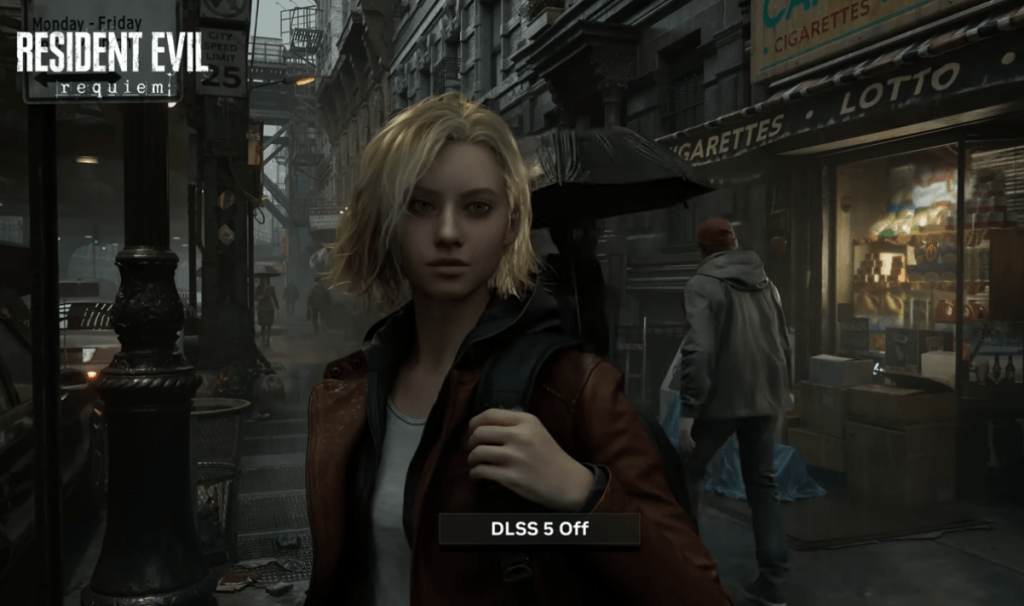
If the AI “invents” a rock texture, is it a rock that fits the game’s world, or is it a generic, photorealistic asset that feels out of place? If it generates lighting effects, do they support the intended mood, or are they just technically impressive but artistically irrelevant?
A case in point involves Resident Evil Requiem’s Grace Ashford, featured prominently in NVIDIA’s announcement trailer for DLSS 5. The new model renders Grace in high fidelity, but also applies dark roots to her previously ash blond hair, sculpted eyebrows only achievable with an eyebrow pencil, and more defined, fuller lips. Some liken the effect to that of a beauty filter. Does DLSS make Grace look more real? Yes. Does it make her look like a different, older, more confident character than the young and inexperienced FBI desk-jockey that players are introduced to? Also yes. Is this what Capcom wants? If it was your game, would you want generative AI to make these kinds of decisions for you?
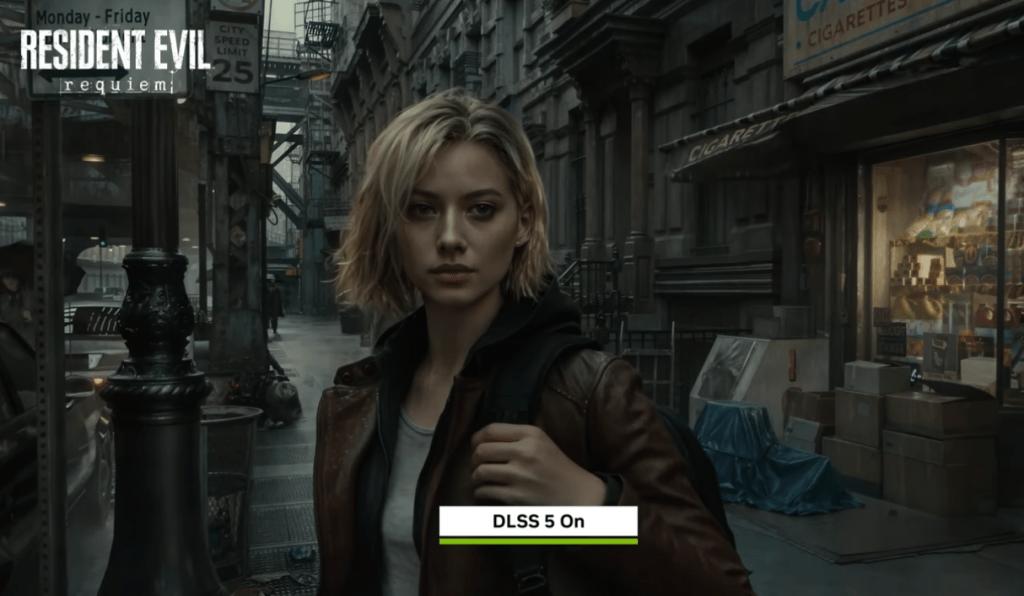
And while some gamers are focusing their attention on Grace in the foreground of NVIDIA’s new demo trailer, there are other even more glaring inconstancies happening elsewhere within the same frame. The rain-slicked street is replaced by a more uniform tone that now interprets rain as fog. This has the unintended effect of making the street a brighter more well lit space. Not quite as scary now, huh? Light sources have multiplied too, reflecting off every surface and from multiple directions at once. It’s as if every object has been given a glow up. Look at me! I’m a lamppost! I’m a shiny car! I’m an NPC!
Moving beyond Grace and Leon in Resident Evil Requiem, the demo showcased other games including Hogwarts Legacy, Starfield, and EA Sports FC 26 with similar confusing results. Facial features appeared super life-like, even in games where the other characters were designed to look more fantastical and cartoon-like.

Obviously the big concern here is that the unique art style a developer worked hard to cultivate could be steamrolled by a generic, “AI-optimal” look. People are questioning whether DLSS understands the myriad nuances that make a single frame so much more than a collection of geometry, textures, and lighting, all photo-realised and yassified to the shiniest degree possible.
Is photorealism the holy grail of video game graphics? Is photorealism the end point for art? (What if every painting you saw in an art gallery looked like a photograph? Would we call that progress?) Or are the companies pushing water-guzzling, PC component price-inflating AI technologies at test audiences who didn’t ask for any of it just telling us it is? Does every game character need to look 100% real? What about games that don’t aspire to hyper realism? What about games that have achieved a sense of realism without resorting to Generative AI?

NVIDIA is on the AI bandwagon, charting a path toward a fundamentally different way of thinking about game graphics. Huang insists he sees DLSS 5 as a revolutionary tool that unlocks visual possibilities previously thought unattainable. For many of us though, this latest shiny Generative AI tool feels like the same threat to artistic agency in a different wrapper, in addition to paving the way towards an era of algorithmically generated, homogenized “content” rather than crafted art.
The ultimate success or failure of DLSS 5 won’t be determined by NVIDIA’s marketing or by the fervor of its critics. It will depend on the degree of control NVIDIA can give back to developers.
If DLSS 5 can be implemented not as a blunt instrument that takes over visual design, but as a sophisticated tool that artists can guide and constrain — a system that respects the “controllability” that Huang speaks of — it may very well become the transformative technology NVIDIA envisions.
But if the final output feels like more “AI slop,” or if developers find themselves fighting the AI to preserve their creative vision, this controversy surrounding DLSS 5 is likely only the beginning.
