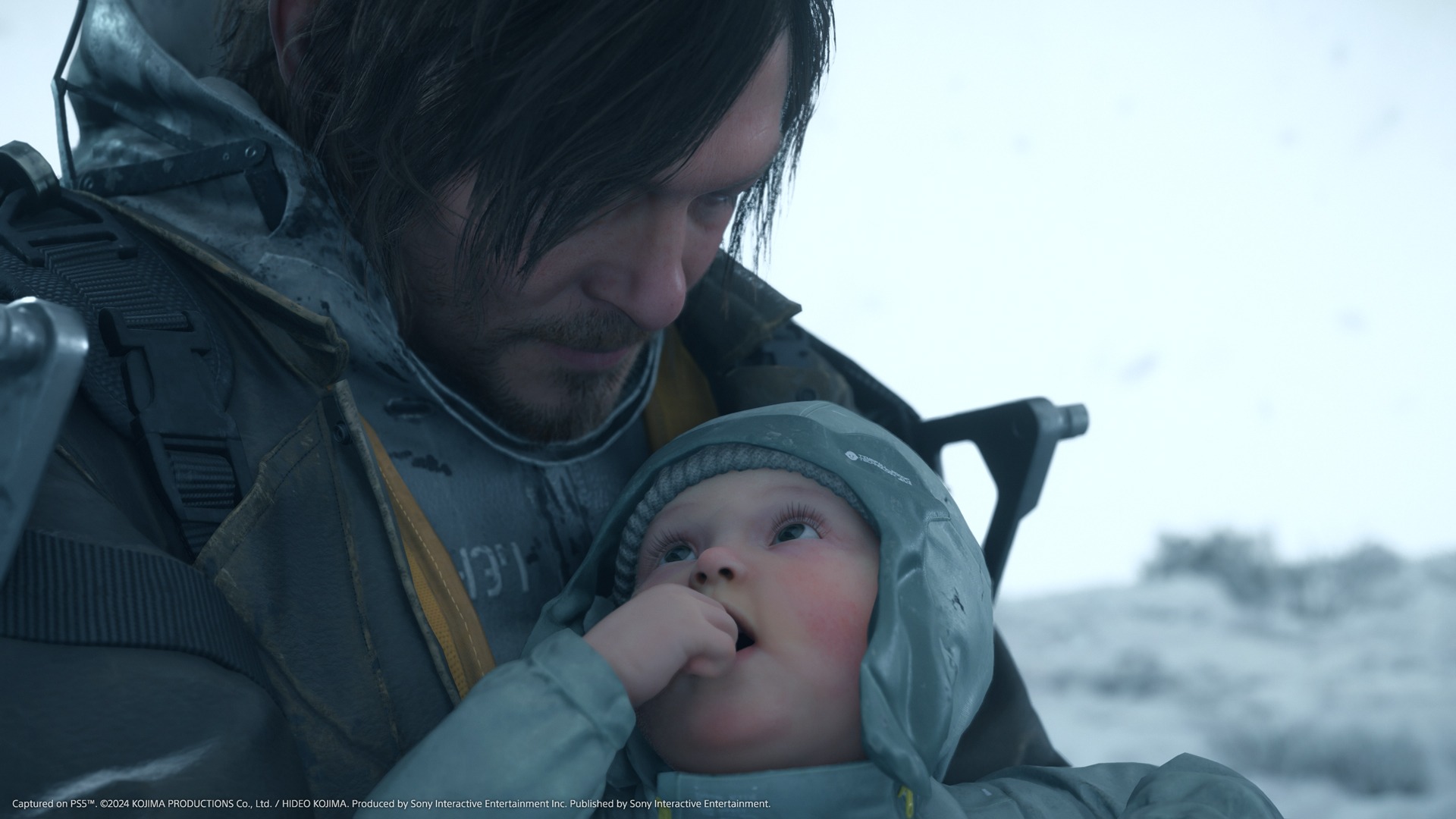
If On the Beach marks your first foray into Hideo Kojima’s colorful Death Stranding universe then you will no doubt be by bowled over his expansive, meticulously detailed, beautiful, and occasionally bonkers world. If on the other hand, you came to the game having first played its 2019 predecessor then you may be dogged by a nagging sense of the familiar throughout the 70+hours of this masterful but flawed second outing.
That feeling probably won’t be immediate. Kojima Productions kicks off this eagerly anticipated sequel in high gear with an emotional, tense, and action-packed prologue involving our main characters Sam Porter Bridges (Norman Reedus), and baby Lou, now an adorable apple-cheeked toddler.
When we first meet them, Sam and Lou are ekeing out a modest existence on the run from the now defunct BRIDGES corporation. However, Lou is still BRIDGES’ property and who can say if they’ll want her back? Sam is not willing to take a chance on that score. However, when Fragile (Léa Seydoux) comes to Sam with a job offer that, if completed, will secure his and Lou’s security and freedom in perpetuity he instantly agrees. Unbeknownst to Sam he is taking on a world of pain that will eventually place him in Australia (the game’s central location), once again working as a porter to establish a Chiral Network on a new continent.

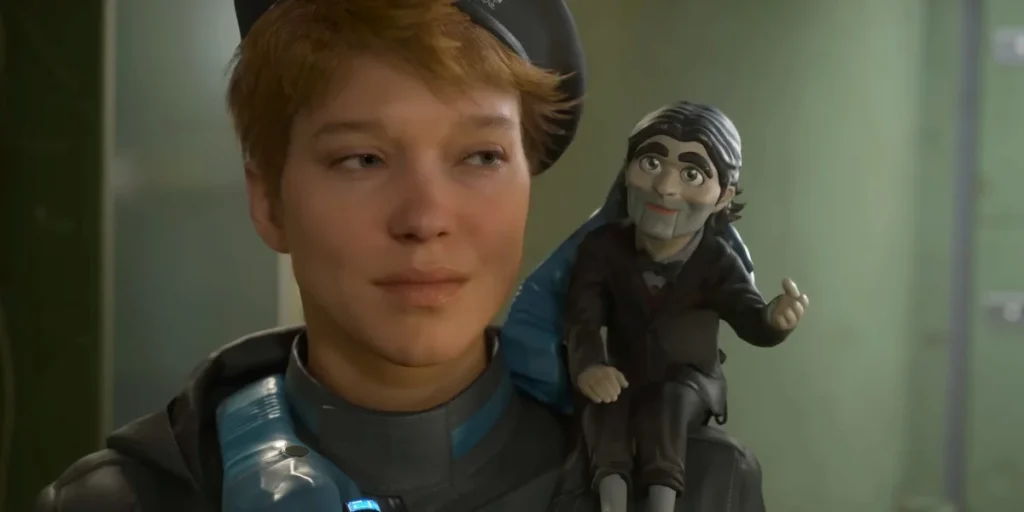
This time around Sam is working for DRAWBRIDGE, a motley collection of individuals with familiarly on-the-nose names: Tarman (George Miller/Marty Rhone) the Captain of the DHV Magellan, a tar travelling ship and Sam’s base of operations; Dollman (Fatih Akin/Jonathan Roumie), a man whose ‘Ka’ inhabits a miniature puppet; Rainy (Shioli Kutsuna) a young pregnant woman with helpful Timefall-controlling abilities, and Tomorrow (Elle Fanning), a mysterious foundling with powerful abilities and a mysterious backstory. Even Heartman (Nicolas Winding Refn/Darren Jacobs), and Deadman (Guillermo del Toro) show up to help out.
Of course, it wouldn’t be Death Stranding without an appearance or five from the grandstanding Higgs (Troy Baker), who turns up with his army of Ghost Mechs to make mischief, grandiose speeches, and generally thwart Sam’s plans at key intervals. This time around though it’s more Neil Vana (Luca Marinelli) who serves as the game’s main antagonist, pursuing Sam through a series of otherworldly arenas, flanked by his squad of spectral soldiers, and feeling like a retread of Mads Mikkelsen’s Cliff Unger from the first game. In fact, there’s a lot to Death Stranding 2 that feels like the original game in slightly different costuming. But before we talk about that, let’s look at what works, because what comes together, comes together rather beautifully.

Sam’s main base is the aforementioned DHV Magellan, a tar-travelling ship in which he sleeps, showers (he’s still doing that), converses with his friends, and even takes part in VR training. Over time, Sam’s room fills up with mementoes of his travels to date, and the people he has met. Of course, the DHV Magellan’s main purpose is as a means to fast travel under the tar. The act of doing so is an eerily beautiful, blue-tinged experience that never gets old. As Tarman, Fragile and Sam travel, the bridge teems with fish silhouettes that dart around oblivious to your presence, a reminder that you are not simply traveling through tar but travelling through tar.
As before, Sam can choose to get about on foot if he prefers, or to take a number of specialized and customizable vehicles. Ladders, floating carriers, and zip lines are likewise a carry-over from the first game, but added to these means of navigating the desolate, sun-scorched Australian frontier are Coffin Boards (a kind of eerie surfboard that navigates on land and tar and is powered by Chiral crystals), Transponders (Sam can instantly transport himself — minus his deliveries — to another transponder location), Chiral Hot Springs (take a dip, see where you end up!) and of course the old faithful road, which Sam can build to make navigating the treacherous landscape a breeze, so long as he can provide the raw materials needed. Sam can even help repair a disused monorail and get about on that if the mood strikes you.
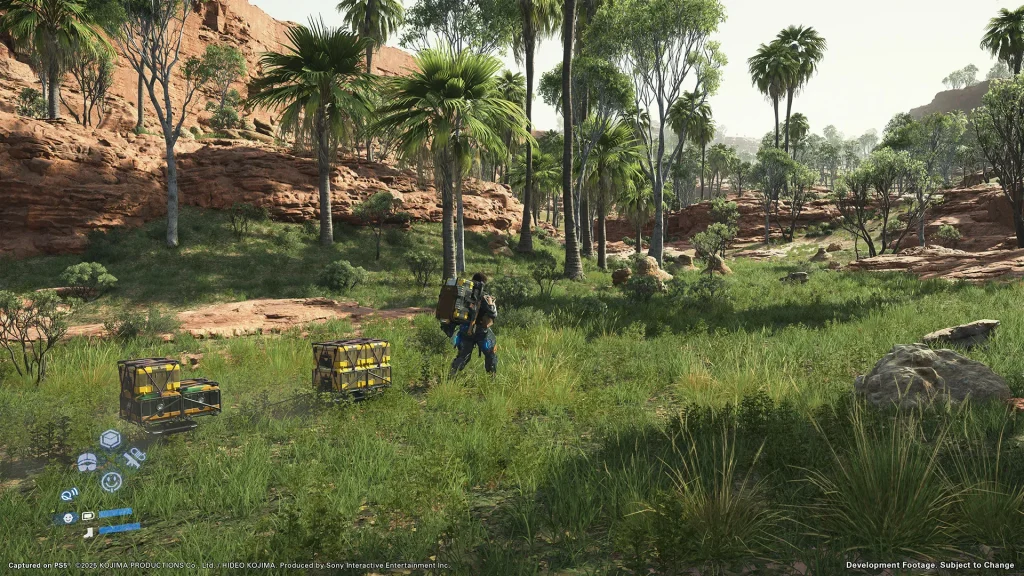
Players can also help each other out by constructing structures and signs, or by donating raw materials. Sam can put up a sign asking for a building materials donation, but will find himself more successful if he is more generous in turn. As before, he can also “like” other players’ structures to show gratitude.
Road building is a satisfying experience in DS2 for those who enjoy the task of constructing. It’s truly a joy to link various completed sections together and breeze over miles of smooth asphalt, taking in the lumpy hazardous scenery below as you whizz silkily by. In fact, the proposition of a smooth polished surface of a completed road is such a lure you may find yourself giving over hours of game time in your quest to pave paradise.
Stop that! There are jobs to be done.
Exactly as before, Sam’s job is to navigate to a Knot (a large outpost), or to a series of colonies, preppers, and survivors (smaller outposts) and connect them to the Chiral communications Network. They’ll ask Sam to deliver goods to their neighbors, pick up items and bring them back, and find missing deliveries dropped by misadventure or theft along the way. Adventuring in an Australian dystopia replete with sandstorms, quakes, and rising floodwaters adds a new dimension to traversal, while bandits, Timefall, BTs, Tar lakes, and monstrous Tar entities still continue to pose a threat. Little wonder the locals want Sam to do the leg work on their behalf!
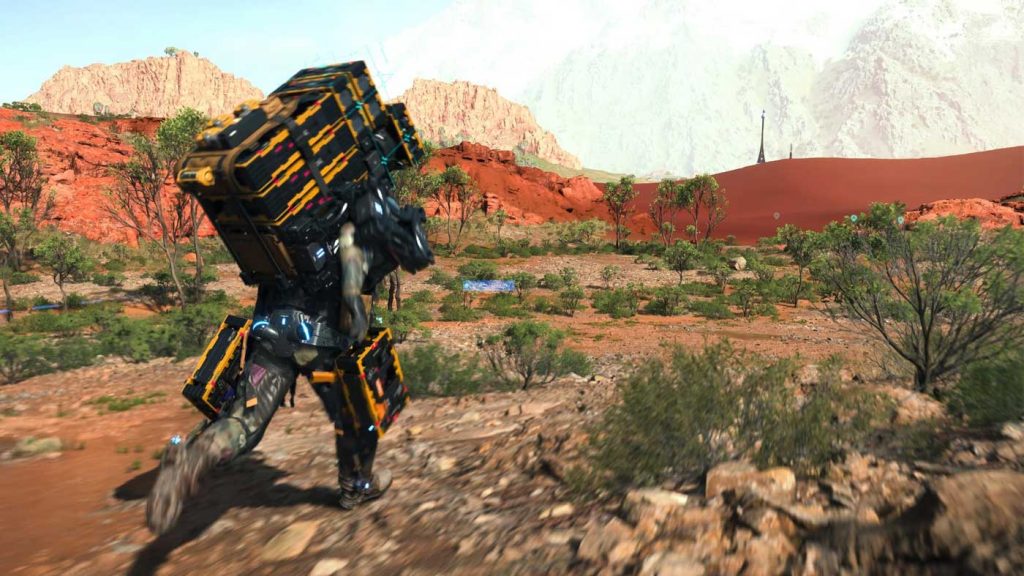
As Sam advances, he unlocks upgrades through the Automated Porter Assistant System (APAS), the game’s skill tree, which splits into five branches: porter, combat, stealth, servicemanship, and bridge link, all of which enhance Sam’s package delivery abilities, and odds of remaining alive while on the job. Completing routine tasks, such as delivering packages, clearing bandit camps, and taking on special missions on behalf of DRAWBRIDGE incrementally boosts Sam’s attributes, slowly improving his skills over time.
BTs, although present, are not as prolific as before, with BT and boss combat pretty much mirroring the action of the first game. Collect blood bags and blood-infused weapons like the blood boomerang for special enemy hits. Otherwise pepper the bad guys liberally with your arsenal of weaponry, including the handgun, pistol, shotgun, Tranq sniper rifle (the bane of bandits everywhere), and in later stages of the game the battle guitar, and rocket launcher.
There are over 60 weapons overall, including variants and vehicle-mounted options such as turret drones. Non-lethal weapons dominate to fit the series’ theme of connection over killing. Killing humans is frowned on both by the community, and the game, and actually reduces Sam’s Social Strand levels — as I found out by when I accidentally mowed down two friendly waving porters whose mangled bodies lingered for days… Most weapons come from raising facility connections (via deliveries), completing orders, and skill tree progress.
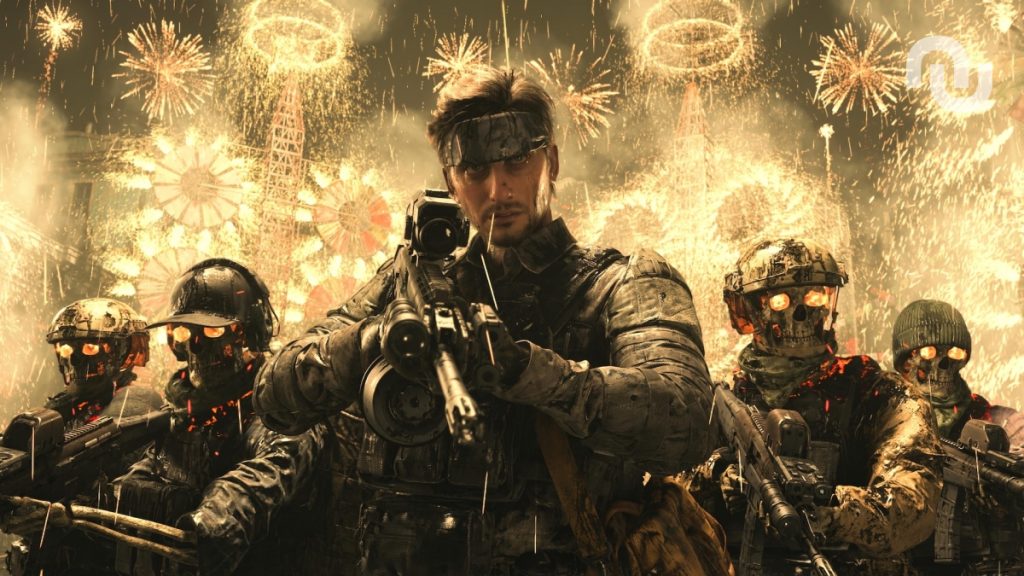
While the nuts and bolts of combat may be familiar, DS2 emphasizes combat more than its predecessor, offering players the choice to confront enemies head-on, or to employ stealth tactics, or to bypass encounters altogether by traversing challenging terrain to get around them. You can also make use of an amusing but occasionally (hey, I don’t judge!) “Pretend You Won” option, which allows you to end a boss battle victoriously, and move on with the story if you’re finding things a bit tough.
But if pretending you won is not your bag it’s good to know that Sam wields an extensive array of tools and gadgets (did I mention the blood boomerang?) to manipulate enemy attention, either by drawing it or diverting it. A new dynamic day-night cycle influences enemy behavior too, which truly adds a strategic depth to proceedings.
These additions make for fun, surprising, and flexible gameplay, and really give the player choice over how they want to play. Rush in guns blazing? Use a sniper rifle to stealthily take out an entire bandit camp before they even know you’re there? Avoid combat altogether? Spend hours connecting up a shiny new road system instead? It’s up to you.

Despite heavy themes and high stakes there’s a sense of the ambitious, the playful, and the absurd everywhere in Death Stranding 2 which illustrates Kojima Productions’ confidence in their product. In what is sure to go down as a little nugget of gaming history, Hideo Kojima famously expressed concern during development that DS2 was “too good” based on early playtest feedback. Fearing it might become too mainstream if universally liked, he commented to composer Woodkid (Yoann Lemoine) that “if everyone likes it, it means it’s mainstream. I don’t want that.” Kojima then allegedly made a series of changes to the script and key events to make it more polarizing and emotionally triggering, aiming for players to initially dislike elements before growing to love them deeply. He later clarified that this wasn’t about deliberately making it weird but ensuring it stuck with players long-term by pushing boundaries, while also enhancing playability and fun. For the most part, most people would agree Kojima succeeded.
However Death Stranding 2 is not without it flaws. Like peeping at the Great and Powerful Oz behind the curtain, we can really see some glaring game mechanics this time around — particularly throughout the narrative elements of the game. The storyline draws major parallels to the first game, but not in a way that subverts expectations in any new way. Instead certain story beats feel copied almost to the letter, particularly in relation to the character of Neil Vana (Luca Marinelli) whose ominous appearances and murky agenda baldly recreates Mads Mikkelsen’s Cliff Unger from the first game. Hitting the same major story beats as its predecessor, Vana’s storyline (which would have been electrifying if we had not seen Mikkelsen’s performance) subtracts from the sense of wonder the game has so carefully constructed in other areas, in addition to essentially spoiling the outcome in advance for those familiar with Death Stranding 1.
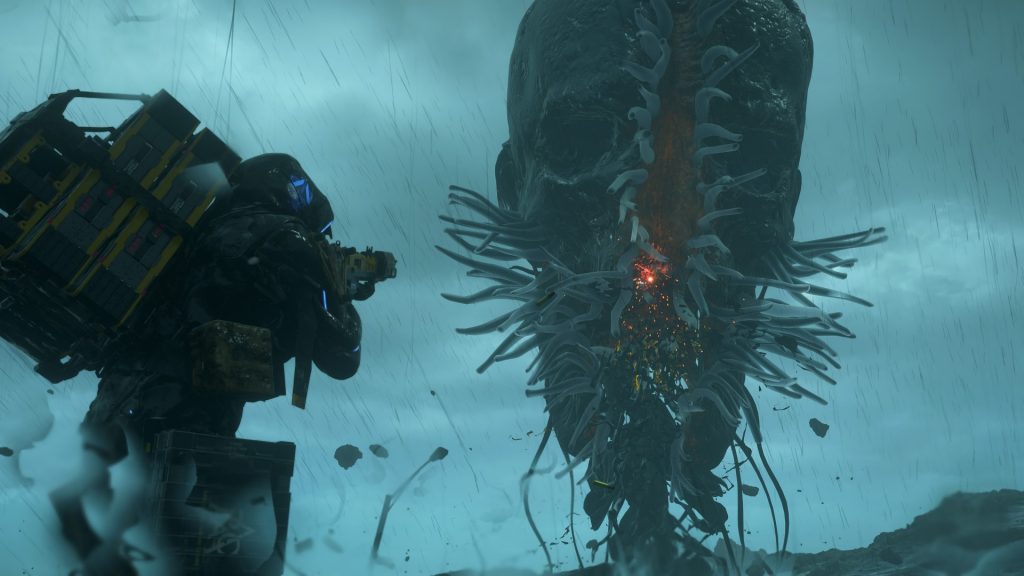
And while some story beats are poignant, there is a sense of the self referential at times that feels, not just tonally out of step with the events at hand, but having the unintended effect of jarring the player from a sense of immersion. In one scene, Dollman chastises Sam for not knowing what Kojima Productions is. In another, Sam looks up at the stars while bathing in a Hot Spring to see Hideo Kojima’s face as a starry constellation beaming down at him. These scattered references — of which there are several — are obvious moments of whimsy stuck like band aids to to the game’s painful themes of grief and isolation, but they can feel unintentionally cringe-inducing and hubristic nonetheless.
In a more glaring fault, it also bears noting that for a game stacked with acting talent, some actors get very little to say in Death Stranding 2. Elle Fanning (whose lengthy list of TV and film credits precedes her) has very little dialogue, impactful though Tomorrow’s rare moments of speech are.
In fact, the game’s main female characters — perhaps with the exception of Fragile — often feel infantilized and one note, coming across as the embodiment of certain ideals rather than fully fleshed human beings in their own right. Compare Rainy with Dollman or Fragile with Tarman to see how dialogue is divvied up between the game’s core characters. Even the average colonist will treat Sam to 5 minutes worth of backstory every time he drops off a delivery. Death Stranding 2 seems to prefer its women to be silently mysterious or silently sexy or silently happy, without much deviation.
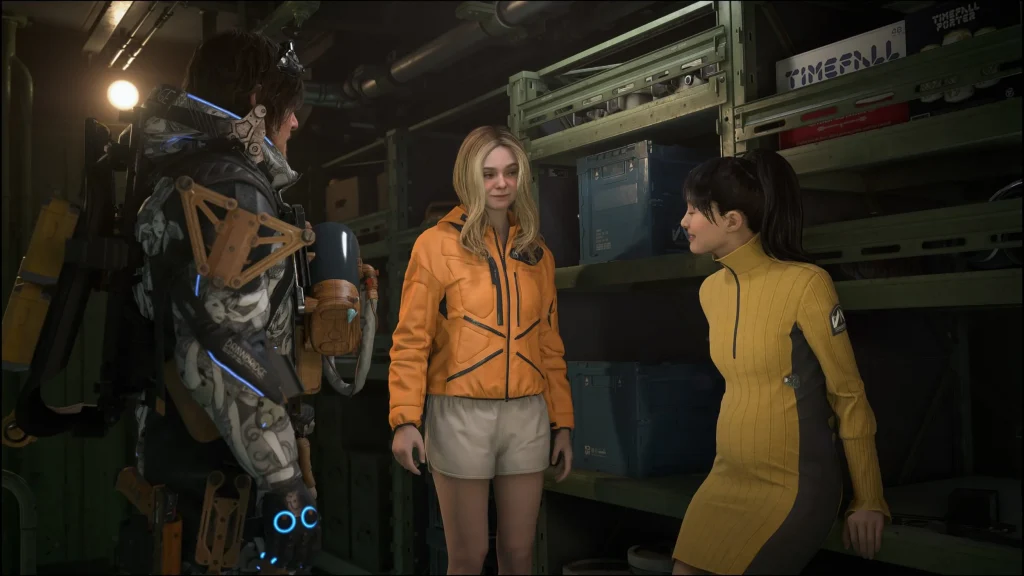
In spite of these missteps, the narrative is still capable of landing emotional punches. Sam’s bond with Lou grounds the story in heart-wrenching stakes, while characters like Tarman and Dollman bring humor and warmth to the bleakness. Even Neil Vana’s derivative arc delivers spectacle, with otherworldly boss fights that dazzle, despite their familiarity. Kojima’s polarizing tweaks — those divisive story changes he made to avoid mainstream appeal — pay off in moments of raw, unsettling emotion, especially in the final hours of gameplay where themes of grief and connection hit hardest.
A final gripe involves just how repetitive Death Stranding 2: On the Beach‘s core delivery loop actually is. Ambitious story, breathtaking visuals, and inventive game mechanics aside, a lot of the game involves the process of accepting hologram briefs, picking up cargo, traversing hazardous terrain, and delivering packages, a mechanic wholly unchanged from the first game.
Often, Sam will find packages belonging to colonists on the far side of the map, or will be asked to backtrack over previously traversed ground repeatedly. These missions are necessary for Sam to unlock upgrades through the APAS system. Without them he won’t be able to connect a major Knot, fight a boss, and earn the next storyline cut scene to advance the plot. After 20-30 hours of back and forth, even in a game as majestic in scope as Death Stranding 2, things can start to feel deeply repetitive.
Despite Kojima’s lofty claim that the game needed polarization to keep it from becoming too universally praised, Death Stranding 2 often struggles to step out from the shadow of its predecessor.
So the sequel is not the revolutionary leap some hoped for, but it’s a refined, ambitious evolution of its predecessor’s vision. It’s a game that dares to be divisive, blending the mundane with the profound, the absurd with the heartfelt.
For newcomers, it’s a mind-bending introduction to Kojima’s world. For veterans, it’s a familiar road worth traveling again so long as you don’t expect a completely new path. If you’re ready to embrace its quirks and endure its grind, this is a journey down under that lingers long after the final delivery.
Genre: Action Adventure. Platforms: PlayStation 5. Release Date: 06/26/25. Studio: Kojima Productions. Publisher: Sony Interactive Entertainment.
Death Stranding 2: On the Beach: Death Stranding 2: On the Beach is a singular experience that demands to be played. Players will be drawn to its lush visuals, beautiful environments, flexible combat options, and heartfelt story, along with some polarizing moments of profound silliness. However this sequel's retread of some characters, and under utilization of others, coupled with the grindy nature of gameplay keeps it from earning a top spot. – jgriffin